Just Because I Could
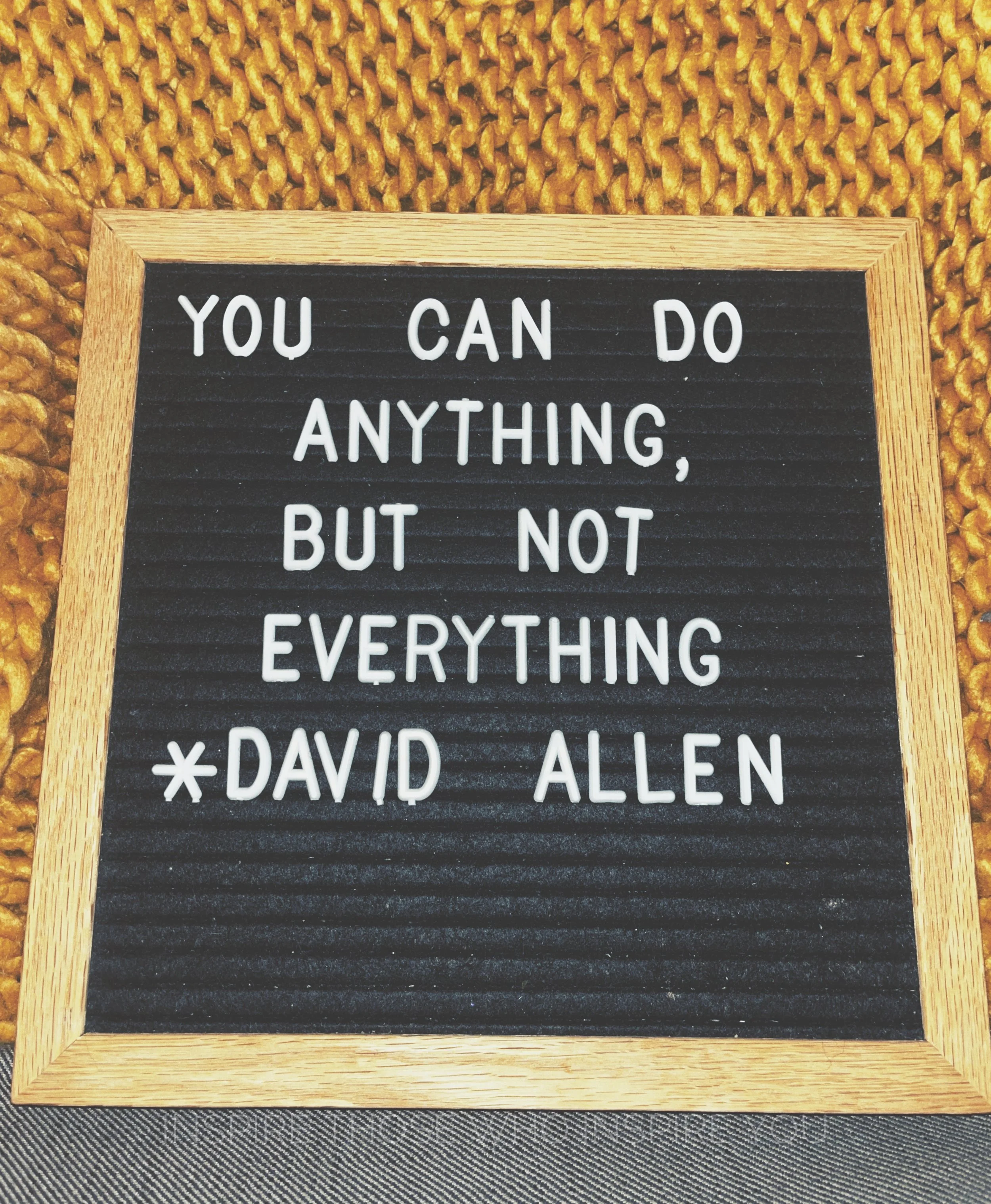
Placed on a letter board is a quote from David Allen that says, “You can do anything, but not everything”
Editor’s note: This is written from my current vantage point
Welcome back everyone, to the next chapter of Life Taking Shape, a series about the shifts that happen as we grow, outgrow, question, learn, and evolve. Not always with certainty, but through experience. Through each season, challenge, and realization, we are constantly becoming.
So far, this series has explored the many ways growth can reshape our lives. In Still Becoming, we reflected on the uncertainty that often comes with identity shifts and the realization that becoming isn’t always something we recognize in real time. In Learning Out Loud, we explored the role curiosity plays in personal growth and what happens when we stop expecting ourselves to have everything figured out before moving forward. Then, in What Emerged Instead, we looked at the unexpected lessons that can surface during periods of growth and the realization that expansion doesn’t always look like becoming someone new, but sometimes like reconnecting with what makes us feel most alive. Most recently, A Different Kind of Success examined how personal growth can reshape our definition of success, shifting the focus from external achievements to a life that feels more aligned, meaningful, and fulfilling.
Which brings us to today’s chapter: Just Because I Could.
Because sometimes growth doesn’t just change what we want, it changes the questions we ask. It teaches us that capability and alignment are not always the same thing, and that being able to carry something doesn’t automatically mean it belongs in our lives. Sometimes the next lesson isn’t about whether we can keep going. It’s about whether we still want to.
The more I reflected on what success meant to me, the more I began noticing another pattern, one I hadn’t fully named before. For a long time, I measured opportunities, responsibilities, and expectations by one simple question: Can I do it? If the answer was yes, I often took that as reason enough to keep going. To take on more. To carry more. To continue showing up in the ways people had come to expect from me. But over time, that way of thinking became harder to ignore.
I started to realize that people were often relying on a version of me that was becoming increasingly unsustainable. The dependable one. The capable one. The one who could be counted on to take on more, hold more, and keep things moving without much hesitation. In many ways, those were the same qualities that had helped me succeed. They made me reliable. They made me trustworthy. They made me someone others felt comfortable turning to. But what I began to question was whether the things that made me successful were also the things making me fulfilled.
Because capacity and desire are not always the same thing. For years, I assumed that if I could do something, I should. If I had the ability, the work ethic, the discipline, or the space to take something on, then it made sense to say yes. But being capable and being aligned are not always the same thing. Just because something fits within our capacity doesn’t automatically mean it belongs in our lives.
Once I began questioning that mindset, I started to understand something else. The issue wasn’t competence itself, it was what competence had a tendency to attract. The more reliable you are, the more likely it is that people will ask more of you. At first, that kind of reliability can feel rewarding. It can feel like trust. Like recognition. Like proof that your hard work is being noticed. And in many ways, it is. Being dependable often open doors. It builds credibility, strengthens relationships, and creates opportunities.
But over time, reliability can quietly shift into expectation. And sometimes, those expectations become unfair, or at the very least, unsustainable. What happens when you’re known as the dependable one? The responsible one. The hardworking one. the person who can juggle more, carry more, and still manage to go above and beyond? Often, it means more work. More pressure. More expectations. Less support. Less balance. Less room to step back without disappointing someone.
And at some point, I had to ask myself whether being capable of carrying more was enough reason to keep doing it. At first, it helped me build trust, earn recognition, and create a sense of stability in environments that often felt anything but stable. In my word, reliability looked like managing reports, handling big accounts, juggling larger responsibilities on top of the normal day-to-day demands of my role, and helping train new employees without the title or pay to match. In addition to that, I often communicated issues that needed to be resolved and became someone others turned to when things needed to get done. And for a while, I took pride in that. It felt good to be seen. It felt good to be recognized for my work ethic, my consistency, and my ability to hand pressure. It made me feel valuable.
But somewhere along the way, that recognition began to reveal something else entirely.
What once felt rewarding slowly became harder to separate from the imbalance taking place around me. The more dependable I proved myself to be, the more people seemed to assume I could absorb. More responsibility. More pressure. Fewer breaks. An expectation to stay calm, respectful, and composed while carrying a workload that had quietly become unattainable. And because I had spent so long saying yes, stepping in, and picking up where others left off, saying no started to come with its own kind of guilt. It wasn’t that I had an issue with hard work. In many ways, I liked being busy. I liked having things to do, solving problems, and feeling useful. But there’s a difference between being capable of carrying a lot and being expected to carry it indefinitely.
What people didn’t see was the weight behind it all. They didn’t see the pressure I was carrying behind the scenes, the emotional toll of trying to keep everything moving, or how much energy it took to continue showing up that way day after day. They didn’t see how much of myself I was pouring into simply getting through that season, or how much I kept to myself because I didn’t want to create more tension in an already difficult situation. By the time I started questioning whether any of it was sustainable, the damage had already started to take shape. It cost me more that I realized at the time, including my peace, my patience, my energy, my hobbies, my confidence, my emotional bandwidth, and eventually my health in more ways than one. What looked like dependability from the outside often felt like survival on the inside. And perhaps that’s part of what made it so difficult.
Sometimes success can keep us somewhere longer than love ever would. Not because we’re fulfilled, but because we’re good at it. Because we know what’s expected of us. Because we know how to navigate the chaos, anticipate problems, and manage the emotional roller coaster that comes with it. Even when something has become draining, there can be a strange sense of security in familiarity. At least you know what you’re walking into. At least you know what variables are in play. For me, that was one of the hardest parts. I was good at what I did and I knew what to expect. What made it difficult wasn’t always what I knew, it was what I didn’t. The uncertainty of change. The unknown on the other side of leaving. The possibility that walking away from something I had worked so hard to succeed in might mean stepping into a version of life I couldn’t yet picture for myself.
And I think that’s where the deeper lesson began. Not in learning how much I could carry, but in realizing that growth was asking something different of me. It wasn’t asking me to prove my capacity yet again. it was asking me to become more intentional about where that capacity was going why I was using it, and whether the life I was building still reflected what I actually wanted.
Because one of the biggest shifts I’ve experienced has been learning that growth isn’t just about becoming more capable. Sometimes it’s about becoming more discerning. It’s about recognizing that just because you can do something doesn’t mean you have to keep doing it. It’s about understanding that capability alone is not a good enough reason to stay in roles, relationships, routines, or versions of yourself that no longer feel aligned.
In many ways, that realization felt like an identity shift of its own. Because for so long, I had tied strength to endurance. To how much I could handle. To how much I could push through, carry, absorb, or figure out. But growth began asking me different questions. Not can you do it? But do you want to? Not can you survive this? But is this how you want to live? Not can you keep proving yourself here? But this is still where your energy belongs?
And I think that’s part of what makes growth so powerful. It reminds us that we are allowed to choose differently. Through both free will and the freedom to change our minds, we have the ability to reshape our lives in ways that reflect who we are now, not just who we used to be. We can chase after dreams that once felt out of reach. We can follow our hearts, switch careers, outgrow old beliefs, strengthen our character, change how we show up in the world, and transform the way we think about what’s possible for us.
That, to me, is one of the most beautiful parts of being human. The ability to evolve. To reconsider. To begin again. To choose a life that feels more honest, more intentional, and more aligned than the one we may have built simply because we knew how to carry it.
Looking back, I don’t think the lesson was simply about doing too much. It was about learning that capability and alignment are not the same thing. That being able to carry something doesn’t automatically mean it belongs in your life. That success, reliability, and competence can all become reasons we stay connected to things we’ve quietly outgrown, not becaufaew they still fulfill us, but because we know how to do them well.
For a long time, I believed strength looked like endurance. Like pushing through. Like continuing to show up, take on more, and make it work simply because I could. But growth has taught me that there is another kind of strength too. the kind that asks harder questions. The kind that notices when something no longer fits. The kind that gives itself permission to choose differently, even when doing so means disappointing expectations, walking away from familiarity. or stepping into the unknown.
That’s what Just Because I Could ultimately came to mean for me. Not regret. Not weakness. Not failure. But a reminder that I don’t have to keep proving myself through how much I can carry. That' I’m allowed to want a life that feels more sustainable, more intentional, and more aligned with who I’m becoming. That I’m allowed to outgrow roles, expectations, and identities that we built around my ability to endure them.
And maybe that’s the invitation here. To pause and ask yourself whether there’s something in your life you’ve been continuing simply because you know how to carry it. A role. A responsilibility. A version of yourself. A relationship. A routine. A goal.
So, what would you change if, instead of asking, Can I keep doing this? You asked, Do I still want to?
Because growth isn’t only about discovering what we’re capable of, it’s about deciding what no longer deserves our capacity.
I look forward to seeing you back here on Monday for the final chapter of this series. It’s hard to believe how quickly June has flown by, and that we’re already nearing the end of the month. But before we close it out, there’s still one final reflection waiting for us.
Until then, have a beautiful week and if you’re keeping up with the World Cup, I hope your country and/or teams succeed to the next round of knockouts.
As a signature of my blog, I’d like to end this post with a suggestion to “Pass on kindness.” There’s no time like the present to Inspire Those Who Inspire You. Acts of kindness, no matter how big or small, can have a direct, positive impact on someone else. Go out there today and change someone’s life for the better!
***These are my personal opinions and may not be those of my employer.***