Looking Both Ways
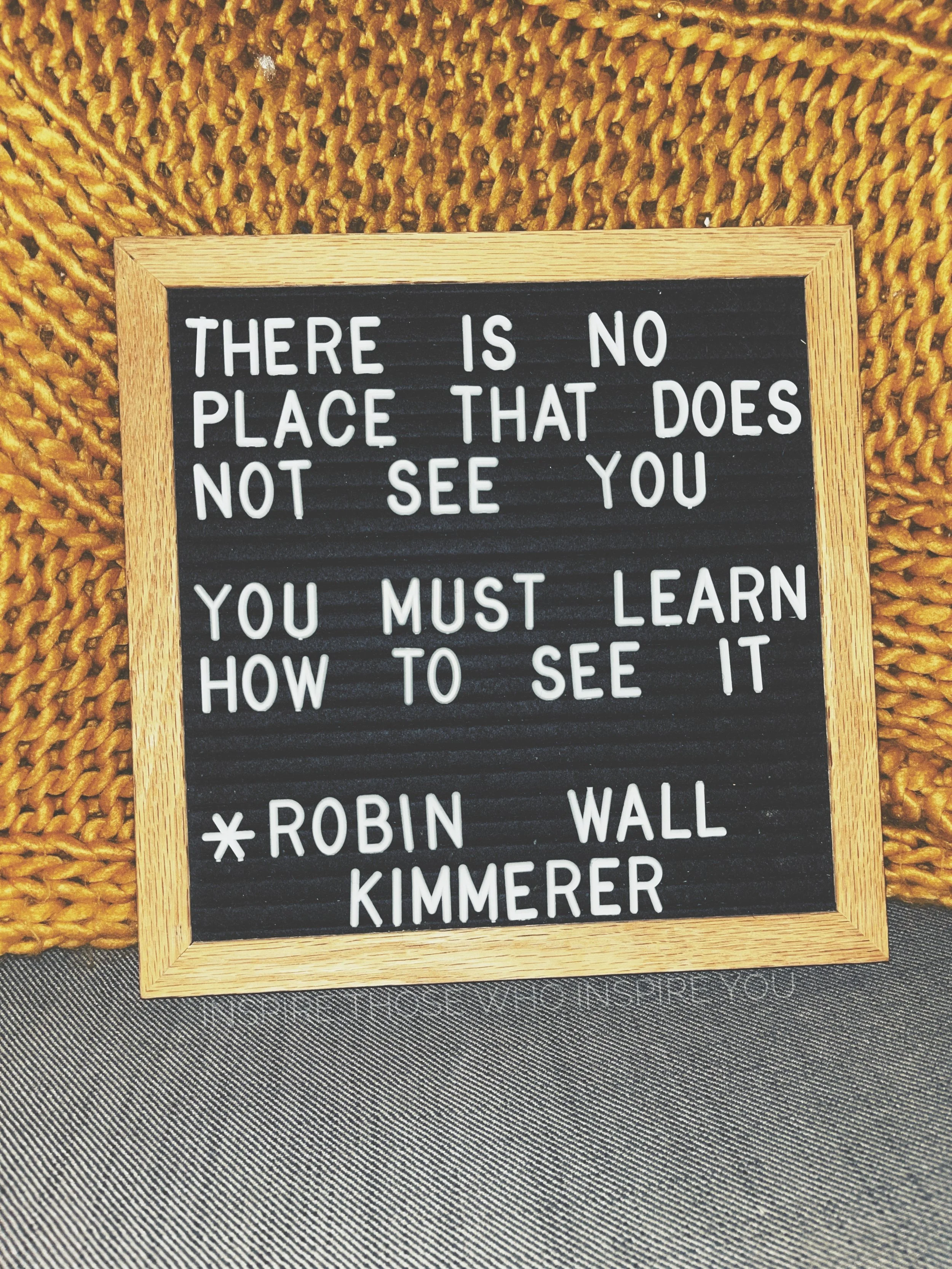
A quote from Robin Wall Kimmerer that reads, “There is no place that does not see you. You must learn how to see it.”
Editor’s note: This is written from my current vantage point
Welcome back, curious minds, kind hearts, and adventurous explorers, to The Places That Make Us series, where together we will explore how the places we inhibit, move through, and remember shape our perspectives, our side of belonging, and who we become. Each post examines a different way place influences the way we see ourselves and the world around us.
But before we get any further into today’s Looking Both Ways post, make sure to check out the first two chapters:
Where We Stand is a reflection on the choices, environments, and values that influence our daily lives. Because where we stand often shapes where we go.
The Walking Mind is built on a simple idea: when your body moves, your mind often follows. Every walk is an opportunity to think, reflect, and reset.
Every one of us experiences the world from somewhere. Long before we form opinions or develop our own worldview, we’re shaped by the places we call home, the communities around us, and the everyday experiences that become familiar over time. Those influences quietly become the lens through which we interpret the world.
It’s easy to assume that the way we see things is simply “the way things are.” But the more we reflect on our own experiences, and the experiences of others, the more we begin to realize that perspective is rarely formed in isolation. It is shaped by where we’ve been, who we’ve met, the cultures we’ve encountered, and the stories we’ve inherited. Before we can understand someone else’s point of view, it helps to recognize that our own perspective has been shaped by a place, too.
Recognizing that truth is an important place to begin, because it reminds us that perspective isn’t something we simply possess, it’s something that has been shaped over time.
Every perspective begins somewhere. Because none of us sees the world from nowhere. Our sense of “normal” is shaped by the communities we grow up in, the landscapes that surround us, the traditions we celebrate, our daily routines, and the kinds of challenges we’re accustomed to solving. In many ways, perspective is always rooted in place.
No matter where we live, the world around us quietly influences how we think. It’s reflected in the information we consume, the people we spend time with, the food we enjoy, the activities we participate in, and the values our communities reinforce. These influences become so familiar that we often stop noticing them altogether. Yet they shape the assumptions we make, the questions we ask, and the way we interpret the world long before we’re even aware of it.
Understanding this does mean our perspective is fixed. Rather, it reminds us that every way of seeing the world has a starting point, including our own.
Once we recognize that every perspective has a starting point, it’s easier to appreciate the value of paying attention to the place closest to us.
Not only is it important to remain open to the wider world, but it’s equally important to remember where we came from. The places that raise us often leave us with values, traditions, and ways of relating to others that continue to shape us long after we’ve left. By appreciating what our own communities have given us, we become better equipped to appreciate what other communities have to offer as well.
For me, one of those gifts was growing up surrounded by diversity. In my neighborhood and throughout high school, I was in the minority. Because of the areas rich history and long-standing ties to the Mexican community, I was immersed in a culture that celebrated family, resilience, and tradition, which was also home to some of the best authentic Mexican food I’ve ever had. More importantly, though, it taught me to be open-minded, to appreciate different perspectives, and to recognize that our differences often enrich our lives rather than divide them.
When I later spent time living in a small town in Wisconsin, I encountered a very different way of life. The pace was slower, nature was never far away, and there was a quiet appreciation for making the most of simple moments. It reminded me that fulfillment isn’t always found in constant activity. Sometimes it’s found in slowing down enough to notice what’s already around us.
Then, when I moved to Texas for school, I experienced another set of values that left a lasting impression. People greeted one another with warmth, they were quick to offer a helping hand, and spoke with a level of courtesy that reflected the importance of respect. “Yes ma’am” and “No sir” weren’t just expressions, they were everyday habits. Friday night lights brought entire communities together, and driving six or more hours to spend time with family or friends was simply considered part of life. That willingness to invest time and effort into people they loved reminded me that relationships are often strengthened not by convenience, but by commitment.
Looking back, each of these places offered something different, and none of the represented the “right” way to live. Instead, each community revealed a different set of strengths and values. Thinking locally, then, isn’t about believing our community is better than anyone else’s. It’s about recognizing the unique lessons our own places have given us while remaining grateful for the opportunity to learn from others.
Just as our local communities have something to teach us, so does the world beyond them. Appreciating where we come from doesn’t require us to stop there. In fact, the more secure we are in our own roots, the more open we often become to learning from the experiences, ideas, and perspectives of others.
Thinking globally invites it to see beyond our own experiences. It encourages empathy for people whose lives, challenges, and opportunities may look very different from our own. It reminds us that our way of doing things isn’t necessarily universal, and that’s not a weakness, it’s one of humanity’s greatest strengths. Across the world, different cultures have developed different ways of solving problems, celebrating traditions, and building communities. Those differences aren’t inherently better or worse. They’re reflections of people adapting to the places and circumstances that have shaped them.
One of the things I find most fascinating is how ideas travel. Sometimes the move across continents, and other times they spread from one community to another in ways we hardly notice. When I first moved to Texas, I was surprised by how common U-turn lanes were, especially along highways. Instead of waiting at a traffic light after missing an exit, there were dedicated lanes that allowed drivers to safely turn around almost immediately. It was such a practical solution that it stuck with me.
Years later, I noticed a similar idea appear in my hometown. While the design isn’t exactly the same, we stop at a traffic light, rather than using a separate lane, it serves the same purpose by making it easier to turn around and head back in the opposite direction. It’s a small example, but it illustrates something much larger. Good ideas aren’t confined to one place. They evolve, they spread, and improve as communities learn from one another.
Thinking globally isn’t only about understanding others cultures, it’s about recognizing that we all have something to contribute and something to learn. When we remain open to new perspectives, we don’t lose our identity, we expand it.
Of course, appreciating both perspectives doesn’t mean balancing them is always easy. Like many things in life, wisdom isn’t found at either extreme, but in learning when each perspective is needed.
Focusing only on our local communities can sometimes cause us to overlook the experiences of people beyond them. At the same time, becoming so concerned with the wider world that we neglect the people and places closest to us can be just as limiting. Neither perspective is complete on its own. A healthy worldview asks us to care about both.
We see this tension in everyday life. Someone may passionately advocate for addressing homelessness or improving mental health within society while overlooking the struggles of a family member, close friend, or neighbor who needs compassion and support. Yet the opposite can happen as well. We can become so focused on our immediate surroundings that we lose sight of the larger systems and challenges affecting communities far beyond our own. Both perspectives matter because people matter, whether they live next door or halfway around the world.
Our increasingly interconnected world makes that balance more possible and more challenging. We now have unprecedented opportunities to learn from culture, communities, and experiences different from their own. At the same time, interconnectedness can create tension where people assume their own customers, values, or solutions should automatically apply everywhere else. Whether at home or abroad, meaningful change rarely begins by dismissing another person’s lived experience.
Instead, I believe it begins with humility. It means listening before assuming, seeking to understand before trying to persuade, and recognizing that every community has developed its own ways of meeting the challenges it faces. That doesn’t mean every tradition or solution is beyond question, nor does it mean new ideas should be rejected. Some of humanity’s greatest progress has come from sharing knowledge across cultures and learning from one another.
The difference is respect. When curiosity, understanding, and care remain at the center of those conversations, new perspectives become opportunities for growth rather than sources of division. Interconnectedness helps us recognize patterns we might never notice from our own location alone, while local knowledge reminds us that every solution ultimately affects real people in real situations.
I was reminded of this recently while reading The Day My Brother Was Murdered by Gianno Caldwell. The author shared the story of losing his brother and reflected on how that tragedy shaped his perspective. Alongside his own experience, he included the stories of others who had faced similar loss, illustrating how some well-intentioned solutions often created unintended consequences or failed to address the deeper issues people were experiencing. Rather than simply criticizing those approaches, he offered thoughtful alternatives rooted in both lived experience and a desire to improve the system.
That example stayed with me because it reflected the value of looking both ways. Broad perspectives can help us recognize patterns and inspire new ideas, but the people most affected by those ideas often provide the insights that make lasting solutions possible. When we combine the bigger picture with the wisdom of lived experience, we move closer to solutions that are not only effective, but compassionate as well.
So, if looking both ways requires balance, the good news is that perspective isn’t something we’re simply born with, it’s something we can continue to develop throughout our lives.
One of the greatest gifts we can give ourselves is the choice to intentionally widen our perspective. Doing so doesn’t require abandoning where we came from or leaving our values behind. Instead, it invites us to build upon them.
Every meaningful conversation, every book we read, every place we travel, every walk through a new neighborhood, and every moment of genuine curiosity offers an opportunity to see the world through a slightly different lens. Exposure has a remarkable way of expanding our understanding, not by replacing our experiences, but by adding to them.
I’ve found that the more I learn about different people and places, the more I appreciate my own. Rather than weakening our roots, new experiences often help us understand them more deeply. They remind us why certain traditions matter, where our values came from, and how they’ve shaped the person we’ve become.
Our perspective doesn’t grow because we replace one worldview with another. It grows because we continue adding to it. Every experience becomes another piece of the puzzle, helping us see a world that is far more connected, diverse, and beautiful than we could ever understand from a single point of view.
Perhaps the greatest invitation of all is not to choose between looking close or looking far, but to learn when each perspective has something valuable to offer.
Throughout this reflection, we’ve explored how every perspective begins somewhere, how our local communities shape our values and sense of belonging, and how looking beyond them expands our understanding of the people and places that make up our shared world. Neither way of seeing id complete on its own. Our roots give us identity, while our openness gives us perspective. Together, they help us become more thoughtful, empathetic, and compassionate people.
Maybe that’s what it truly means to look both ways. It’s remembering where we came from while remaining curious about where others have come from. It’s valuing the lessons of our own communities while reconging there’s always something new to learn. The more we’re willing to listen, ask questions, and seek understanding, the more complete our picture of the world becomes.
As you go about your week, I invite you to reflect on this: How has the place you call home shaped the way you see the world, and what perspective from someone' else’s experience has changed the way you think?
Thank you for spending part of your day with me and for continuing this journey through The Places That Make Us. Your time, curiosity, and willingness to reflect alongside me mean more than you know.
Therefore, I hope you’ll join me again next Monday for the next chapter, The View From There, where we’ll explore how a single place can unexpectedly change the way we see ourselves and the world around us. Until then, I wish you a wonderful week filled with curiosity, meaningful conversations, and new perspectives wherever life takes you. I look forward to seeing you back here next week.
As a signature of my blog, I’d like to end this post with a suggestion to “Pass on kindness.” There’s no time like the present to Inspire Those Who Inspire You. Acts of kindness, no matter how big or small, can have a direct, positive impact on someone else. Go out there today and change someone’s life for the better!
***These are my personal opinions and may not be those of my employer.***